Last updated on February 7th, 2026 at 02:17 pm
How to get to Merzouga is one of the most common questions travelers ask when planning a trip to the Moroccan Sahara—and the short answer is: by road, tour, or a combination of transport options from Morocco’s major cities. While Merzouga feels remote, it’s surprisingly accessible from Marrakech, Fez, and Casablanca with the right planning.
Located on the edge of the spectacular Erg Chebbi dunes, Merzouga is the gateway to camel treks, desert camps, and unforgettable Sahara landscapes. Reaching it requires a long but scenic journey across mountains, valleys, and desert plains, and the best way to travel depends on your time, budget, luggage, and comfort level.
In this guide, you’ll find all the practical ways to get to Merzouga, detailed routes from Marrakech, Fez, and Casablanca, transportation comparisons, and essential travel tips—so you can choose the option that fits your travel style and start your desert adventure fully prepared.
Disclaimer: This article may contain affiliate links, which means I may earn a small commission if you make a booking or purchase through these links — at no additional cost to you. Thank you for supporting my blog!
Where Is Merzouga Located?
Merzouga is a small village in southeastern Morocco, right on the edge of the spectacular Erg Chebbi dunes, one of the country’s most iconic desert landscapes. It sits close to the Algerian border and belongs to the Drâa–Tafilalet region, making it a gateway to the Sahara.
Although Merzouga feels remote, it’s well connected to Morocco’s major cities by road. Here’s a quick look at the distances:
| Route | Distance (by car) | Time to Get There (by car) |
| Marrakech to Merzouga | Two main routes: – 556 km (typically the fastest) – 679km | 9–11 hours |
| Casablanca to Merzouga | Three main routes: – 655 km (typically the fastest) – 651 km – 684 km (via Rabat) | 9–11 hours |
| Fez to Merzouga | Two main routes: – 476 km – 463 km | 7–8 hours |
The journey typically takes you through dramatic landscapes: High Atlas mountain passes, lush oases, rocky plateaus, and palm-filled valleys. As you get closer, the terrain becomes increasingly arid until the massive golden dunes suddenly appear on the horizon.
Merzouga itself is small and easy to navigate, but many desert camps and hotels are located just outside the village, directly facing the dunes. Roads leading into Merzouga are paved and in good condition, making it accessible by car, bus, or organized tour.
How to Get to Merzouga from Marrakech
Reaching Merzouga from Marrakech is one of the most popular desert routes in Morocco. The journey takes around 9–11 hours, depending on stops. Below are the main ways to travel from Marrakech to Merzouga, along with what each option offers.
By Private Transfer (My personal experience)
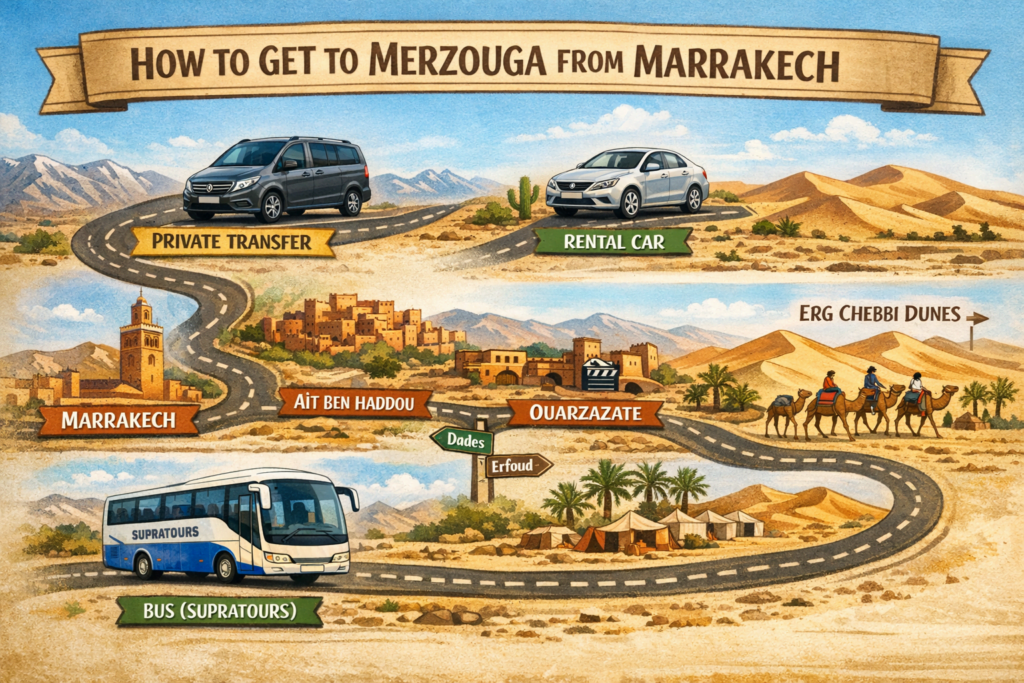
A private transfer is the most comfortable and flexible way to travel from Marrakech to Merzouga, and it’s the option I personally chose.
We were a group of five friends traveling through Morocco for over two weeks, and that meant a lot of heavy luggage. The idea of changing buses, dragging our trolleys across dusty streets, and then pulling them through the sand to reach our desert camp… definitely not appealing.
On top of that, none of us has a driving licence, so renting a car wasn’t even an option.
The private transfer turned out to be perfect. Our guide handled everything: all the bookings, navigating the roads, choosing stops along the way, and organizing tours once we reached the desert.
We didn’t just drive straight to Merzouga — we made scenic stops in the Atlas Mountains, at Kasbahs, the Atlas film studios, a fossil-processing factory, and an argan oil cooperative. It essentially transformed what could have been a long, tiring travel day into a curated road trip.
Because the distance from Marrakech to Merzouga is long, we decided to break the journey with an overnight stay in Ouarzazate, which made the trip much more enjoyable. The next day, we continued refreshed and excited for the desert.
A private transfer is ideal if: you’re traveling as a group, you have a lot of luggage, you want flexibility to stop anywhere, or you prefer a more relaxed, guided experience.
By Rental Car
If you’re comfortable driving long distances and mountain roads, renting a car gives you total freedom.
To make sure you are on the right path, the route looks like this: Marrakech → Tizi n’Tichka Pass (High Atlas Mountains) → Aït Ben Haddou → Ouarzazate → Skoura → Dades/Tinghir → Erfoud → Merzouga
The travel time is around 8–10 hours without major stops (usually more with sightseeing).
This route is incredibly scenic but includes sharp curves in the Atlas Mountains. Once you approach Tinghir and Erfoud, the roads straighten out and become much easier.
Important: Our guide told me that in Morocco, wearing a seatbelt is important. Even the people in the backseat must wear it, and you may be fined if you don’t. We only encountered police cars in big cities, but it’s better to be safe than sorry.
Because you have a long drive, leave early from Marrakech to avoid driving in the dark. In towns and villages, there can be people on the streets or other vehicles driving carelessly, and in the sandy fields, there are animals, including camels.
Make sure you fill up your car in Tinghir or Erfoud, because gas stations become scarce after that.
Also, my recommendation is to plan for frequent stops; the scenery is worth it.
By Bus (Supratours)
The most budget-friendly option is the Supratours bus, which runs a direct service from Marrakech to Merzouga.
The total duration is around 12 hours. I was pleasantly surprised to find out their buses are comfortable and reliable. Luggage is allowed, but not ideal if you’re carrying a lot.
The bus arrives directly in Merzouga village. If your camp is outside town, transfers are usually available, but you may still need to walk through the sand depending on the meeting point.
This option works well for solo travelers or backpackers who don’t mind a long journey. There’s a bus leaving from Marrakech every day at 8 AM and arriving in Merzouga Village at 8 PM.
Please note that in Morocco, we had to pay extra for big or extra luggage. You are only allowed to bring one piece of hand luggage (maximum weight 5 kg) per person for free. For each extra piece of luggage, you need to pay 5 MAD.
By Organized Tour
Many travelers choose a 3-day tour from Marrakech, which includes transportation, accommodation, meals, and activities. This is similar to a private transfer, except you join a larger group, have a dedicated guide, and follow a predetermined schedule.
A typical itinerary includes crossing the High Atlas, visiting Aït Ben Haddou, an overnight stop in Dades or Tinghir, a walk through Todra Gorge, a camel trek at sunset in Merzouga, and a night spent in a desert camp.
This is a good all-in-one option if you prefer everything planned for you and want cultural stops along the way.
How to Get to Merzouga from Fez
Traveling from Fez to Merzouga is slightly shorter than from Marrakech and offers a completely different side of Morocco. Instead of mountain passes and kasbahs, this route takes you through the Middle Atlas Mountains, cedar forests, wide open plateaus, and the lush Ziz Valley. The journey usually takes 7–8 hours, depending on stops and road conditions.
By Private Transfer
A private transfer from Fez to Merzouga is one of the most comfortable and time-efficient ways to reach the desert.
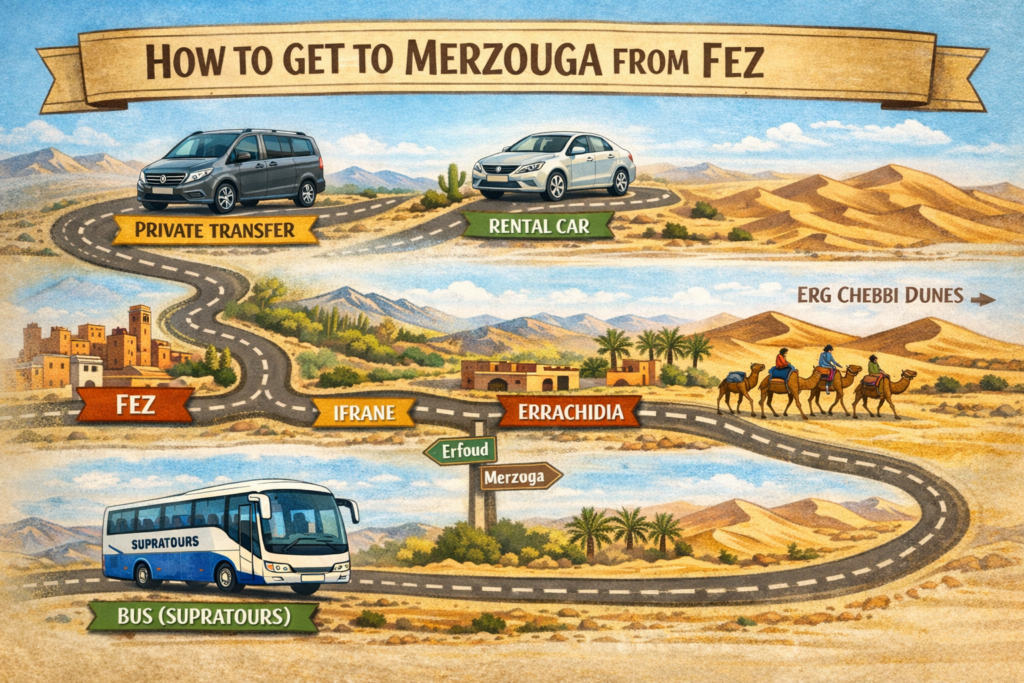
With a private driver or guide, you can travel at your own pace, stop for photos, meals, and sightseeing, and avoid the hassle of coordinating public transportation. Many transfers include scenic stops along the way, such as the cedar forests near Azrou, viewpoints over the Ziz Valley, and towns like Midelt or Errachidia.
This option is ideal if you’re traveling with heavy luggage, you want door-to-door service, or you prefer a relaxed, stress-free journey.
Private transfers can be done in one long day or combined with an overnight stop if you want a slower pace.
By Rental Car
Driving from Fez to Merzouga is straightforward and generally easier than the Marrakech route, as it avoids high mountain passes.
The route looks like this: Fez → Ifrane → Azrou → Midelt → Errachidia → Erfoud → Merzouga
The estimated driving time is 7–8 hours (not including stops).
Highlights along the way include the alpine-style town of Ifrane, the cedar forests where Barbary macaques live, and the dramatic palm groves of the Ziz Valley. Roads are paved and well-maintained, making this a popular self-drive route.
If you choose to drive, it’s best to leave Fez early in the morning, refuel in Midelt or Errachidia, and plan a few scenic breaks, because it’s a beautiful drive.
By Bus
There are reliable bus connections from Fez to Merzouga, mainly operated by Supratours and CTM.
You can expect a travel time of around 9–10 hours. The buses are comfortable. I personally tried CTM, and I didn’t have any complaints. The bus is the most budget-friendly option to get from Fez to Merzouga (around $30/person one way).
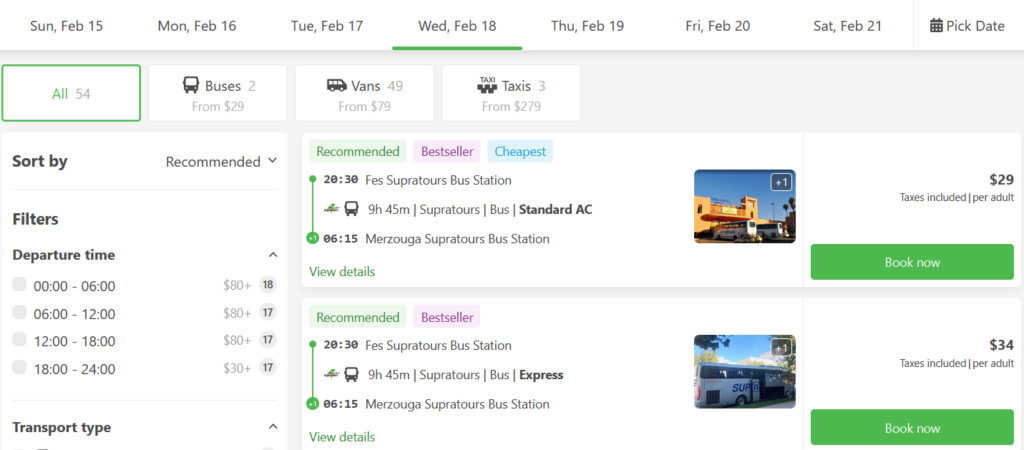
Some buses go directly to Merzouga, while others stop in Erfoud or Rissani, where you may need a taxi to complete the journey. This option is best for travelers on a budget who don’t mind a long day of travel.
I don’t know how the Supratours buses are, because we didn’t get to ride any of them, but we took a lot of rides with CTM. The company offers 2 types of tickets: regular and premium. Because the premiums were relatively cheap, we only bought those. In my experience, the buses are clean and comfortable, and I felt very safe during all the journeys.
By Organized Desert Tour
Many travelers opt for a 2- or 3-day desert tour from Fez, which combines transportation, accommodation, meals, and desert activities.
Typical tours include stops in Ifrane and the Middle Atlas, panoramic views of the Ziz Valley, overnight stays in Midelt or nearby villages, camel trekking into Erg Chebbi, and an overnight stay in a desert camp.
This is a great option if you want to experience the desert without worrying about logistics and plan to continue your journey toward Marrakech afterward.
How to Get to Merzouga from Casablanca
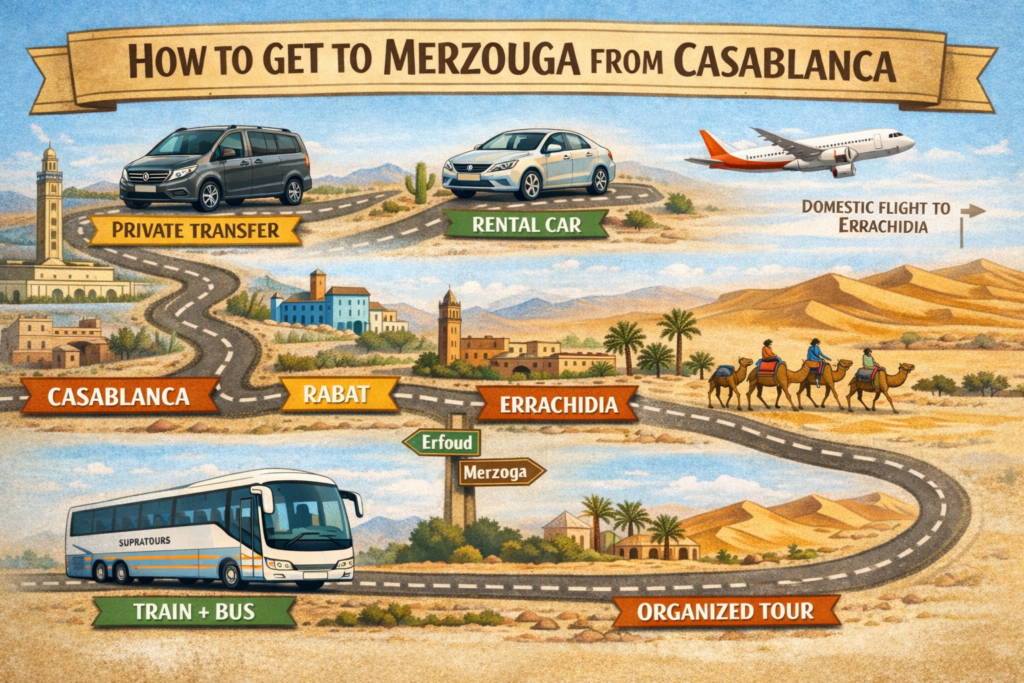
Casablanca is Morocco’s largest city and main international gateway, but it’s also the furthest major city from Merzouga. The journey is longer and requires more planning, but it’s absolutely doable with several transportation options depending on your time, budget, and comfort level. Expect a total travel time of 9–11 hours by road, or less if you combine transport methods.
By Private Transfer
A private transfer from Casablanca to Merzouga is the most comfortable and straightforward option, especially if you’re short on time or traveling with luggage.
The trip can be done in one long day, but many travelers choose to break the journey with an overnight stop—often in Midelt, Errachidia, or even Fez—making the experience far more relaxed. As with other private transfers, you benefit from door-to-door service, flexible stops, and a driver who knows the route well.
This option works best if you want maximum comfort, you’re traveling as a group, or you prefer not to coordinate multiple modes of transport.
By Rental Car
Renting a car from Casablanca gives you full control over your itinerary but requires a long drive.
Here’s the route overview: Casablanca → Rabat → Meknes → Azrou → Midelt → Errachidia → Erfoud → Merzouga
Estimated driving time: 9–11 hours (without long sightseeing stops).
The drive passes through imperial cities, forested mountain regions, and desert valleys. Roads are generally in good condition, but the distance is significant, so it’s best to split the trip over two days if possible.
I advise against driving at night, especially in rural areas. The streets are not well-lit (or not at all), and you can encounter different obstacles, like people or animals.
Refuel whenever possible after Midelt.
Also, consider stopping overnight to reduce fatigue.
By Train + Bus Combo
For travelers who prefer public transportation, combining the train and bus is a practical option.
This combination works like this: You take a train from Casablanca to Meknes or from Casablanca to Fez, then continue by bus (Supratours or CTM) to Merzouga, or to Erfoud/Rissani with a short taxi ride to Merzouga.
The total travel time is around 12–14 hours (often split over two days).
While this option is budget-friendly and reliable, it requires careful scheduling and handling luggage between connections.
By Domestic Flight to Errachidia
If you’re short on time, flying is the fastest way to get closer to Merzouga.
Flights operate between Casablanca and Errachidia
Flight duration: approx. 1 hour 30 minutes
From Errachidia, Merzouga is about 1.5–2 hours by taxi or private transfer
This option significantly reduces travel time and is ideal if you want to maximize your time in the desert. However, flights are limited, so it’s best to book in advance and double-check schedules.
By Organized Desert Tour
Although less common than tours departing from Marrakech or Fez, some operators offer multi-day desert tours that start in Casablanca.
These tours usually include transport, accommodation, meals, and activities, stop in Fez or Midelt along the way, and take several days to reach Merzouga.
This option is ideal if you prefer a fully guided experience from start to finish, without worrying about logistics.
Tips for Traveling to Merzouga
Start early: Distances are long, and daylight driving is safer and more enjoyable—especially if you’re crossing mountain or desert roads.
Pack smart: Bring sunscreen, sunglasses, a hat, comfortable walking shoes, and warm layers for cold desert nights, even in spring or autumn.
Cash is essential: ATMs are limited in Merzouga, and many desert camps and small businesses don’t accept cards. Also, if you want to support locals by buying souvenirs (fossils, mascara, argan oil) or just to thank them for your hospitality (everyone will give you tea and/or sweets), you need cash.
Expect temperature extremes: Days can be hot, nights can be cold—dress in layers.
Plan your luggage: If you’re staying in a desert camp, you’ll usually leave large suitcases at a hotel or meeting point and carry a small overnight bag into the dunes.
Book ahead in high season: Spring and autumn are popular, and camps and transfers sell out quickly.
Respect the desert: Follow your guide’s instructions, avoid wandering off alone, and protect the environment by minimizing waste.
Best time to visit Merzouga Desert: Spring (March–May) and autumn (September–November), when temperatures are warm but manageable, and conditions are ideal for desert activities. Note: We went there in early January, and during the day the temperature was around 15-20 degrees Celsius, but during the night it was freezing. While our tents did have a heater, it was not really enough to have a comfortable temperature, so we slept with a few layers of clothes on.
Top Things to Do in Merzouga
Merzouga is all about desert experiences, and the massive dunes of Erg Chebbi offer plenty of unforgettable activities. Whether you’re staying for one night or several, these are the highlights you shouldn’t miss.
Camel Trek in the Erg Chebbi Dunes
A camel trek at sunset is the classic Merzouga experience. Riding across the dunes as the sky changes color is unforgettable and usually includes an overnight stay in a desert camp.
Spend a Night in a Desert Camp
Sleeping under the stars in the Sahara is a once-in-a-lifetime experience. Camps range from basic to luxury and typically include dinner, breakfast, music around the campfire, and incredible stargazing.
Watch the Sunrise and Sunset
Climbing a dune for sunrise or sunset is simple but magical. The shifting colors of the sand and the silence of the desert make these moments truly special.
Sandboarding
Many desert camps provide sandboards for free. It’s a fun, easy activity that doesn’t require any experience and is best enjoyed on the taller dunes near the camps.
4×4 Desert Adventure
A 4×4 tour lets you explore deeper into the desert, visit nomadic families, see fossil beds, and reach remote viewpoints that are inaccessible on foot.
Visit Khamlia Village
Khamlia is a small village near Merzouga known for its Gnawa music, brought to Morocco by descendants of sub-Saharan Africans. A short visit offers music, tea, and cultural insight.
Stargazing
Thanks to minimal light pollution, Merzouga is an excellent place for stargazing. On clear nights, you can see the Milky Way with the naked eye—especially from desert camps far from the village.
Fossil Hunting Near Erfoud
The region around Erfoud is famous for fossils. You can visit workshops where fossils are cleaned and transformed into decorative pieces and furniture.
Conclusions: How to Get to Merzouga
Getting to Merzouga may take time, but the journey is an essential part of the experience. Whether you travel from Marrakech, Fez, or Casablanca, each route offers unique landscapes and unforgettable stops along the way.
For travelers seeking ease and flexibility, private transfers and guided tours offer the most relaxed experience. More adventurous travelers may prefer renting a car or using public transport, while those short on time can combine flights with ground transport.
No matter how you get there, Merzouga rewards the effort with towering dunes, star-filled skies, and one of the most memorable desert experiences in Morocco. Take it slow, enjoy the journey, and let the Sahara do the rest.